Do you want to know about the latest trends?

Local Uniqueness: Seville

A store that reinterprets the tradition of ceramics and historic architecture from a contemporary perspective.

Seville’s history is one marked by contrasting lights, intense colours and materials as ancient as the earth itself. A city where traditional craftsmanship and architecture interact organically, shaping a deeply rooted cultural identity. In this context, the MANGO store on O’Donnell Street is conceived as a space that not only fits into this universe, but reinterprets and highlights it.

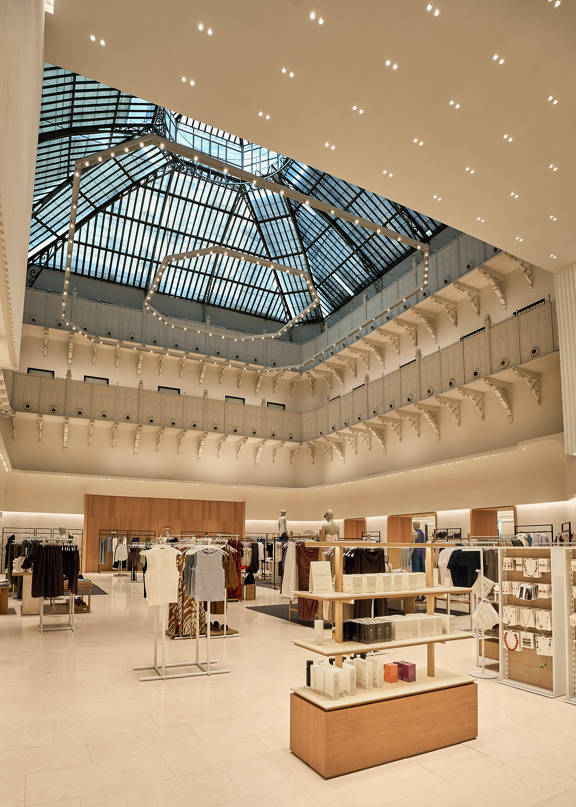
Located in the heart of the historic centre, the store occupies a unique site: the former Palacio Central cinema, which in the early 20th century was the Kursaal. The building’s refurbishment has made it possible to restore iconic architectural features such as the montera, the glass dome and the theatre’s original 19th-century stalls. This starting point, steeped in history, defines the character of the Local Uniqueness project, an initiative by our Retail Design team that seeks to link each store with the culture, art and architecture of its surroundings.

In Seville, this approach leads to arista ceramics, a technique of Mudejar origin dating back to the 15th century that has left a profound mark on Andalusian architecture. Found in palaces and historic buildings, it is characterised by its geometric reliefs and intense glazes, becoming an expression of local identity and artisanal expertise.

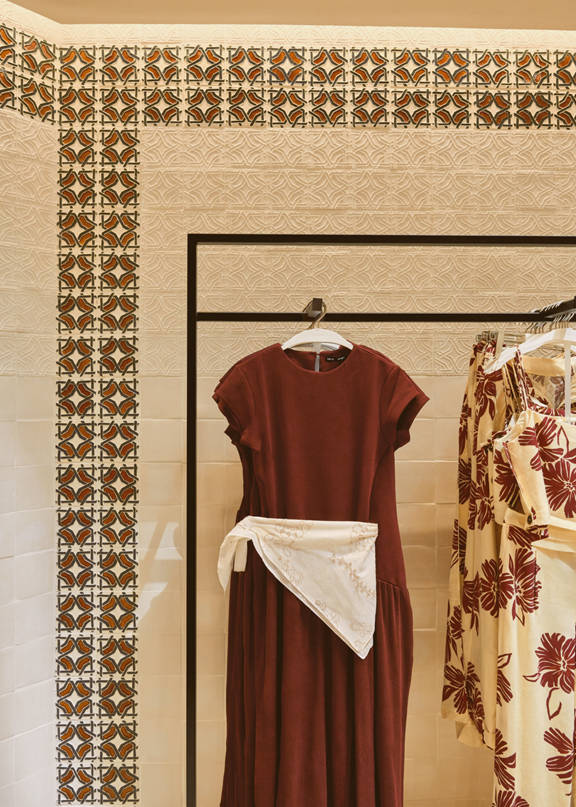
The project’s development is underpinned by a collaboration with Cerámicas Sevilla 1952, a family-run workshop that has kept this technique alive across several generations. Through a process of constant exchange, the team proposed transforming the shop’s walls into a visual narrative of the ceramic-making process, so that visitors can discover the evolution of the arista technique across different stages as they move through the space. From the plain tile in its purest form, through the white relief that emphasises its sculptural character, to the gradual application of colour—first in a single shade and finally in two—which adds depth. Ceramics cease to be a mere finish and become a language, a narrative, a tangible memory.

The result is a space that transcends its commercial function to become a point of connection with the city. The integration of local craftsmanship, respect for the original architecture and attention to detail create an experience that highlights Seville’s identity from a contemporary perspective.

Through Local Uniqueness, every project becomes an opportunity to forge genuine connections with the surroundings. In Seville, this approach takes shape in a space where tradition unfolds naturally and finds new forms of expression in the present.
Seville’s history is one marked by contrasting lights, intense colours and materials as ancient as the earth itself. A city where traditional craftsmanship and architecture interact organically, shaping a deeply rooted cultural identity. In this context, the MANGO store on O’Donnell Street is conceived as a space that not only fits into this universe, but reinterprets and highlights it.

Located in the heart of the historic centre, the store occupies a unique site: the former Palacio Central cinema, which in the early 20th century was the Kursaal. The building’s refurbishment has made it possible to restore iconic architectural features such as the montera, the glass dome and the theatre’s original 19th-century stalls. This starting point, steeped in history, defines the character of the Local Uniqueness project, an initiative by our Retail Design team that seeks to link each store with the culture, art and architecture of its surroundings.

In Seville, this approach leads to arista ceramics, a technique of Mudejar origin dating back to the 15th century that has left a profound mark on Andalusian architecture. Found in palaces and historic buildings, it is characterised by its geometric reliefs and intense glazes, becoming an expression of local identity and artisanal expertise.

The project’s development is underpinned by a collaboration with Cerámicas Sevilla 1952, a family-run workshop that has kept this technique alive across several generations. Through a process of constant exchange, the team proposed transforming the shop’s walls into a visual narrative of the ceramic-making process, so that visitors can discover the evolution of the arista technique across different stages as they move through the space. From the plain tile in its purest form, through the white relief that emphasises its sculptural character, to the gradual application of colour—first in a single shade and finally in two—which adds depth. Ceramics cease to be a mere finish and become a language, a narrative, a tangible memory.

The result is a space that transcends its commercial function to become a point of connection with the city. The integration of local craftsmanship, respect for the original architecture and attention to detail create an experience that highlights Seville’s identity from a contemporary perspective.

Through Local Uniqueness, every project becomes an opportunity to forge genuine connections with the surroundings. In Seville, this approach takes shape in a space where tradition unfolds naturally and finds new forms of expression in the present.
Seville’s history is one marked by contrasting lights, intense colours and materials as ancient as the earth itself. A city where traditional craftsmanship and architecture interact organically, shaping a deeply rooted cultural identity. In this context, the MANGO store on O’Donnell Street is conceived as a space that not only fits into this universe, but reinterprets and highlights it.

Located in the heart of the historic centre, the store occupies a unique site: the former Palacio Central cinema, which in the early 20th century was the Kursaal. The building’s refurbishment has made it possible to restore iconic architectural features such as the montera, the glass dome and the theatre’s original 19th-century stalls. This starting point, steeped in history, defines the character of the Local Uniqueness project, an initiative by our Retail Design team that seeks to link each store with the culture, art and architecture of its surroundings.

In Seville, this approach leads to arista ceramics, a technique of Mudejar origin dating back to the 15th century that has left a profound mark on Andalusian architecture. Found in palaces and historic buildings, it is characterised by its geometric reliefs and intense glazes, becoming an expression of local identity and artisanal expertise.

The project’s development is underpinned by a collaboration with Cerámicas Sevilla 1952, a family-run workshop that has kept this technique alive across several generations. Through a process of constant exchange, the team proposed transforming the shop’s walls into a visual narrative of the ceramic-making process, so that visitors can discover the evolution of the arista technique across different stages as they move through the space. From the plain tile in its purest form, through the white relief that emphasises its sculptural character, to the gradual application of colour—first in a single shade and finally in two—which adds depth. Ceramics cease to be a mere finish and become a language, a narrative, a tangible memory.

The result is a space that transcends its commercial function to become a point of connection with the city. The integration of local craftsmanship, respect for the original architecture and attention to detail create an experience that highlights Seville’s identity from a contemporary perspective.

Through Local Uniqueness, every project becomes an opportunity to forge genuine connections with the surroundings. In Seville, this approach takes shape in a space where tradition unfolds naturally and finds new forms of expression in the present.
Cookies enhance your shopping experience

We use our own and third-party cookies for analytical purposes and to show you personalized advertising and content based on a profile prepared from your browsing habits. You can accept all the cookies or manage your preferences in the settings panel. For more information, please consult the Cookies Policy.